
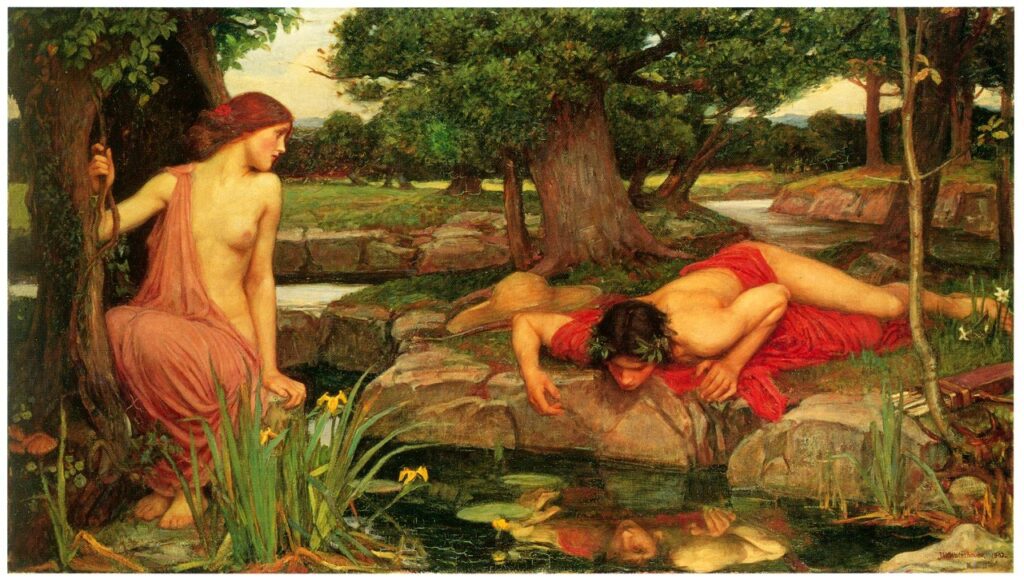
However, there may be something culturally significant about these “Echo-inflected” articles and websites. For they seem to suggest that today Echo has collectively begun to emerge from her lonely valleys and forest caves and has begun to find her voice. This is a good thing. And we can see this in her modern-day exemplars—from Anita Hill to E Jean Carrol, from E Jean Carrol to the Epstein files, and in the Me Too movement as a whole. And those victimized voices are legitimately needing to be heard. For when the wider culture can’t empathically hear them, parts of the culture remain narcissistic—and sexual and other forms of predation can remain underrecognized and unpunished.
*
Yet mythically, the testimony of Echo may be a little suspect—she’s not quite an innocent victim. For in her back story, and prior to her encounter with Narcissus, she couldn’t tell the truth to Hera about the whereabouts of Hera’s philandering husband Zeus. Instead, Echo entertained Hera with long distracting stories while knowing that Zeus was having affairs with his mountain nymphs.
And for this attempt on the part of Echo to stay on “the good side of power “(Zeus) Echo was cursed by Hera. Henceforth Echo would not be able to initiate conversations. Instead, she would only be able to “echo” the last words of what someone else said.
And today, we may suffer an “Echo complex”—and not only when we’ve felt victimized by narcissists. Such can happen when people become tongue-tied in meetings with important people or face the challenges of public speaking.
And significantly, we might recognize Echo as well in political parties, or nations taken over by autocratic leaders, where vast numbers of people also try to “stay on the good side of power,” and are only able to echo the last words of these leaders. Leaders in many cases who are not only narcissistic, but psychopaths and sociopaths to boot. For one of the largely misunderstood things about personality disorders is that if someone suffers from a personality disorder, it’s rarely the case that they suffer from that personality disorder, and that one alone.
But a central point here is this: Just as there’s no single “correct” way to understand a myth, the perspective of Echo isn’t the only way to view narcissism. For narcissism is actually a far larger phenomenon. And to understand it better, we might consider the perspective offered by the other figures in the myth of Narcissus and Echo, and hopefully thus come to a more panoramic view; one that might come to recognize how all the figures in this myth may live inside us too. And that includes Narcissus himself.
And all of them contain some element of an identity confusion, whereby people take themselves to be what they are not, rather than knowing themselves in a deeper way. Yet this deeper form of self-knowledge was quite central in the Roman poet Ovid’s version of the myth of Narcissus. For in his version, at the myth’s very beginning, Narcissus’s concerned mother seeks counsel from the omniscient Tiresias about her son. And what Tiresias tells her is: Your son may live to a ripe old age—providing that he never comes to know himself (for that would surely lead to his death).
What kind of “self-knowledge” is this—that is deadly to Narcissus—and by extension, to narcissism itself? This pivotal question has been largely unconsidered in our understanding of narcissism. Yet this lack of self-knowledgeprecludes us from a deeper view of ourselves, and everyone else.
For Narcissus is not just a freakish character in an ancient myth. And he’s as present today as he was when first recognized by the Greek and Roman poets of long ago. How exactly do we put that self-absorbed perspective (inside us all) out of its isolative misery?
How do we free ourselves from his identity confusion—the pitiful confusion Narcissus exhibits when he tries to embrace the radiant image (of himself) that he sees reflected in a mysterious pool? For that image was misperceived by Narcissus—there’s nothing real standing behind it—and so, Narcissus only manages to get his hands wet. Yet further, how do we evolve beyond Narcissus’s lack of empathy, and the trail of jilted lovers—both male and female—that he’s left behind in his wake?
And if all young children go through a healthy phase of narcissism that has been termed the King Baby, it suggests that narcissism in adults is a case not only of a grandiose, and mistaken sense of identity, but a developmental arrest.
*
Unfortunately, a certain kind of self-knowledge has been missing as well in many of the psychological professionals leading our discourse on narcissism. And why “the official estimate” of American narcissism in the past two editions of the Diagnostic and Statistical Manual of Mental Disorders (published by the American Psychiatric Association) have been so dubiously low. While in 2010, the personality disorder committee of the Manual that had already thrown psychopaths and sociopaths overboard, announced they were about to banish Narcissistic Personality Disorder as well.
This was met by such an outcry from practicing clinicians, that when edition 5 was finally published in May of 2013, the NPD diagnosis was retained; yet with no mention of any new research supporting its estimated range (between 0 percent of the American populace and 6.2 percent). What should be our takeaways here?
Option one: That when the official diagnostic and statistical manual of the APA considers the estimated range of NPD in Americans could be as minimal as 0%—their same estimate as many years ago—then not only is narcissism not on the rise, but it barely exists in America. Other reportage must be heretical rumor-mongering, an insult to a great nation’s mental health. There’s really nothing more to see, understand, or be concerned about here. Narcissism in America is but fake news—a complete nothing burger.
Option two: The DSM has its head up its ass—at least when it comes to personality disorders, and pronouncements about them made by academics in committees; and should be defrocked of any assumption of authority.
Option three, and more soberly: That without a more mythically panoramic view—one that includes the kind of self-knowledge that is fatal to narcissism—we will only continue to have a limited understanding of narcissism—and what might be required for its healing.
In fact, the lack of a more panoramic view is part of why narcissism remains as rampant today as it was over two thousand years ago when Greek and Roman poets gave us their numerous versions of the myth of Narcissus and Echo. And of them all, only the version provided by the Roman poet Ovid possessed the kind of “self-knowledge” still missing today.
We could also explore a number of related themes. One is that this transformational and “fatal” self-knowledge has always been held and conveyed by the esoteric adepts of the world’s spiritual traditions. And for millennia they’ve offered transformational gazes similar to the one that led to Narcissus’s fatal vision into that strange, reflective pool (that Ovid told us doesn’t reflect “ordinary things” like cattle, birds, or even the sun).
Another is, that modern psychology—beginning with Freud—made an unfortunate and limiting move a hundred years ago, when it elected to entirely divorce itself from its close cousins— the world’s religious and spiritual traditions. (I will also write about why this was initially understandable). Though even today a spiritually neutered approach to the psyche has limited the discipline of modern psychology from being better able to recognize, let alone treat narcissism in its multiple forms.
And as mentioned, there are actually several different forms—or narcissistic styles—from the relatively benign “closet narcissism” spoken of by James Masterson to the truly toxic “malignant narcissism” recognized by Otto Kernberg, and that Erich Fromm found to be “the quintessence of evil.”
These were not “minor league clinicians.” Yet neither they nor these styles are even mentioned in what purports to be America’s definitive diagnostic and statistical manual of mental disorders.
While an undisputed fact is that Greek and Roman poets first named narcissism, and wrote their versions of the myth of Narcissus over two thousand years ago—which makes narcissism, arguably, the first recognized personality disorder.
But consider this: That within a year or so of its outbreak, clever humans devised vaccines that were efficacious in limiting the spread of the Covid virus. Yet strangely, we seem as baffled in fully understanding and successfully treating the social virus of narcissism, as were the people in antiquity. Isn’t there something that can be done about this?
But these are not normal times. We live in a world where, for better or worse, anything could happen at any moment.And the crucial inflection point we’re facing now—that includes ecological, political, and evolutionary crises— could lead to the “increased necessity” that both Jung and Gurdjieff recognized as pivotal for transformation.