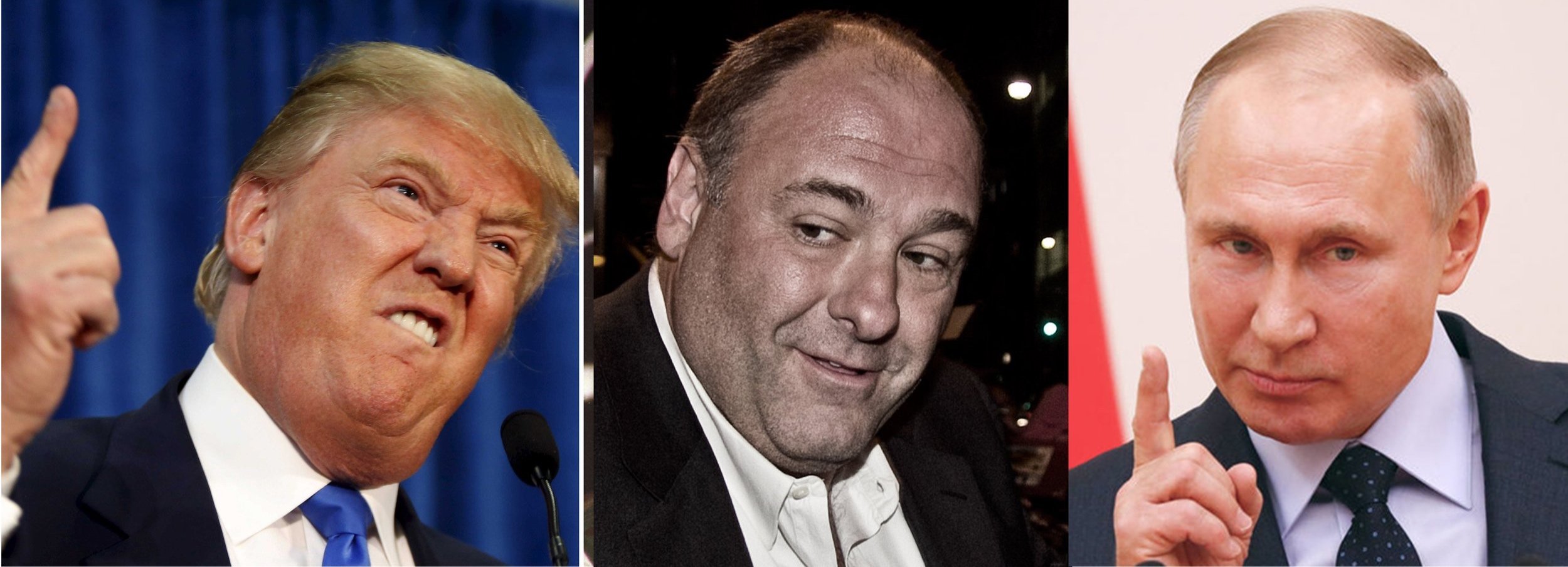
Television’s Tony Soprano and Ray Donovan are sociopaths, but not psychopaths. Both had criminal fathers, and followed them by committing multiple crimes themselves. Yet they both expressed caring for family members, and had other redeeming qualities. Similarly, squat Peter Clemenza of the Godfather is a killer, yet also a devoted family member. Once he’s overseen Paulie’s murder in the back of his black sedan, he famously instructs his assistant to ditch the gun, keep the cannoli.
While Ray Donovan’s menacing father Mickey Donovan–portrayed by the actor Jon Voight–is a psychopath, and he constantly exploits and imperils even his own family with his chaotic schemes. This leads Ray to stop whatever he’s doing, and drive in his black sedan to aid his family members. While psychopaths are incapable of caring for, or about others. They can be impulsively chaotic. And psychopaths care only about themselves–which also makes them narcissistic.
According to Harvard psychiatrist Lance Dodes, Donald Trump’s father Fred was a psychopath. But according to Mary L. Trump, Donald’s niece–who’s a clinical psychologist–Fred Trump was a high functioning sociopath, as is his son Donald. Which of these credentialed mental health experts were correct in their diagnosis of the personality disorder prevailing in the Trump family? The correct answer is they both were right.
For Donald Trump could validly be diagnosed as a psychopath, a sociopath, and a narcissist–and a malignant narcissist at that. He’s chaotic to the max–yet cares not about the well-being of America, its constitution, or America’s allies; he cares only about himself. He has no conscience, or loyalty to anyone or anything else.
Geopolitically, Trump allies himself with other of the world’s autocrats who likewise exhibit exploitive, antidemocratic, psychopathic features–whether in Russia, North Korea, China, Hungary, or Israel. For as it’s been said of psychopaths: Birds of this feather tend to flock together.
But having said the above, I’d be remiss not to allow the official diagnostic and statistical manual of American psychiatry to weigh in. Thirty years ago they threw both sociopaths and psychopaths out of their manual, as if both no longer exist. Both were replaced by the manual’s self-invented construct–the Antisocial Personality Disorder–a similar, but different construct. (Hare didn’t dispute the validity of ASPD as a construct–in fact he said that far more people are ASPD than psychopaths). Yet psychopaths have, and continue to imperil our world in a way that far out-punches their numerical ranking.
In 2010, as the DSM was readying to release its latest edition (finally published in May of 2013), it was announced they were also about to throw Narcissistic Personality Disorder (NPD) out of the manual. But this was met by such an uproar by practicing mental health professionals, that they reversed their stance. Clinicians thus, could continue to employ the diagnosis. (Yet how obviously irrelevant would US psychiatry have become, if psychopaths, sociopaths, and narcissists had all become banished from its official manual of mental disorders? And during an epoch that only six years later would find America led by a president who could be diagnosed by all three of these disorders.)
However, and without any apparent new research, the personality disorder committee of the DSM maintained the same estimate of the prevalence of NPD as that published in the previous edition (DSM-4). And it told us that the estimated prevalence of Narcissistic Personality Disorder in the American population could be as low as 0%–at the low end of their estimate and no more than 6.2% at the high end.
These low-ball estimates simply didn’t jibe with what many psychotherapists had found showing up in their consulting rooms. Nor did they jibe with the longest running research study ever conducted on narcissism in America by a group of social psychologists. In the two plus decades of this study, their findings were that narcissism had increased by 30% during the study’s duration. And by the study’s end, two thirds of the college students being tested were scoring highly on a narcissism index. The controversial juxtaposition of these two estimates of American narcissism couldn’t be more jarring.
And so, if you believe that the presence of narcissism in America could be as low as 0 to 6.2%, that could be overlooking a lot of narcissism that’s simply become normative and thus harder to recognize–what we might now call “the narcissism of everyday life.” And this is but one of the reasons that narcissism has been badly in need of a revisioning.